By
Dr. Saint
PREAMBLE
Cultural tradition across the globe entails customs, beliefs, ethics and values that signify fundamental attributes of every tribal identity. From time immemorial, these attributes are found manifesting in the traditional clothing, music, griot, dance, religious ceremonies, traditional worships and political governance of every tribes.
In Nigeria, Ijebu has been one prominent tribe distinctly identified by the attributes of their ancestral heritages for over millennium. Aside from the unique dialect and native foods, Ijebus before 1892 used to practise a traditional system of worship that relates their people to the supernatural or connects them to the divinities through rituals, veneration of deities, and festivals.
THE PRE-COLONIAL IJEBU ODE
Up till early 19th century, Ijebu Ode was described to be a small village surrounded by a ditch with which the palace of the king was fenced with red mud. It was described to be the Mother-Town to all other Ijebu settlements with Awujale as the Spiritual head.
The entrance into the then Ijebu Ode village was positioned at the place known today to be Odo Esa. At the entrance lied the shrines of about four deities where rituals were offered to their ancestors. And no stranger dare enters without permission, reason it reflects in their Oriki as Ijebu Ọmọ onígbò Mawo Mawo. Àjòjì to bawo yio di ebora amuso …
IJEBU TRADITION OF WORSHIP
Over the centuries, the Ijebus in Nigeria were typical religious people who were prominent for an institutionalized traditional convention that had contributed to the unity and numerical explosion of the land before the advent of religious colonization by the expatriates.
Ijebus in the past had the records of over twenty indigenous deities spread across the land that people annually devote time to worship. Amongst these were the worship of Osowusi, Agemo, Ebi, Ososi, Leguru, Sungbo and many others. The grand style of the tradition was a festival known in the past to be IDELE ODEDA Festival.
WHAT IS THIS FESTIVAL ALL ABOUT?
IDELE ODEDA FESTIVAL was an organized set of special events aimed at reminiscing the ancestors through the worship of the deities, and celebrating the heritage amidst pageantries. According to the tradition, it was a cultural festival during which the hunters, Masquraders, blacksmith, Osun worshipers and the Legurus (original name for the IFA Priests during the era), converge for annual traditional religious celebration.
Funny enough, this religious belief and cultural practices were what Captain Clapperton in 1826 and Captain Bedingfeld in 1862, during their visit to Ijebu Ode, misconstrued to be paganism in their respective perspectives, with subsequent intent to infiltrate the land with the western belief.
TRADITIONAL RELIGIOUS FESTIVAL
The Idele Odeda festival used to be an event where all Chief Priests under the head of Modisa of Idele converged to unanimously usher sacred prayers for the entire land amidst picnic celebration. According to primitive Ijebu tradition, Modisas were the custodians of the deities (which other people called Aboore) while Legurus were the Ifa Priests.
As ancestrally established, the Idele Odeda festival used to be celebrated for three consecutive days. On the first day, all Ijebu Legurus will converge for Ifa divination to enquire of what spiritually at stake for the land. Also, the Modisas carried out the propitiation at Odo-Esa as religious worship to their ancestors. At the sunset of the day, Awujale leads the Legurus and Modisas to visit Sungbo shrine at Oke Eri to offer sacred prayers for the entire land. The prayers at Sungbo tomb had been the tradition of Ijebu since time immemorial until later aborted in 1934 by Awujale Adesanya.
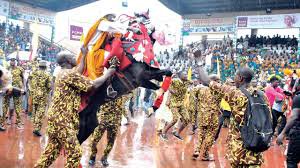
During the second day, all the hunters, Masquraders, blacksmith, Osun worshipers, Modisas and the Legurus from far and near would converge at open ground in Idele for the cultural pageant. Idele was the picnic arcade for the ancient Ijebu Ode where Awujale visits once in every year. The activities include cultural displays, chants of Ijala, Gbedu dance, magical performances, Agemo dance and many more.
The third day, the leaders of all the traditional group chose to visit the Palace of Awujale with encomium to pay homages for witnessing the year’s celebration. During this day, many royal fathers from all other Ijebu settlements will send tributes to Awujale in conformity to the annual tradition.
This festival had been the cultural norm of the Ijebu tradition before the infiltration of Islam into the land, the incident that led to the shifting of Agemo dance to Imosan.
THE GENESIS OF IDELE ODEDA EXTINCTION
The cultural tradition known as Idele-Odeda festival began to witness antagonism in 1878 after the influential dignitaries who used to promote the festival had got converted into Islam. Dignitaries that included Chief Balogun Odejayi, Abasi Odunsi, Buraimo Kugbagbe, and some ODIs.
It means the extinction of the festival began at the introduction of Islam to Ijebu Ode around 1878 by the Ijebu Ode traders who travelled to Ilorin, but returned with some Ilorin trade partners. Their influx carried a huge influence and instigated the preaching against using human beings for rituals.
In the beginning, the practice of Islam by these strangers was done in secrecy. These pioneer observers could not pray in the open for the fear of sanctions by the ODIs, because Awujale Fidipote at the time was frankly indisposed to any tradition that against the custom of the land. Anything considered been an affront to the norms was instantaneously punished.
Within 1878 to 1880, the accusation against the practice of Islam in the land became prominent, particularly the setting ablaze of the houses and farms of the prominent first coverts. The revolution of attack against the early converts continued to gain momentum, but which further woo the sympathy of majority amongst which included prominent leaders like Lawani Ita-Ogbin, Sanni Oboromboro and others.
OPEN DOOR FOR ISLAM’S GROWTH
The introduction of Islam consequently divided the town, instigated clash amongst the Chiefs with the king, and contributed to the civil unrest that forced Oba Fidipote into exile in 1882.
While in exile, the preaching of Islam got intensified as the converts wake at early hour of the day going house to house with melodious evangelism. These intensified efforts led to how the head of the palace Odi called Aroboto accepted the Islam. Fortunately, his acceptance massively contributed to the growing population of Muslim since that 1882.
Now that the principal Odis who were expected to enforce sanctions against the Muslim had accepted Islam, the cultural paradigm of the land became affected leading to gross converts from their traditional beliefs.
CONSEQUENCE ON IDELE ODEDA FESTIVAL
After 1882 departure of Oba Fidipote to exile, records have it that the year’s celebration of Idele Odeda festival shrouded with suspicion of invasion by the Muslims. The festival could not hold because there was no traditional ruler to give order, and particularly most of the influential Chiefs of the land had revoked their beliefs in their ancestral traditional worship.
Consequent upon this, the festival could not hold in Idele but in order to help mitigate the crisis, the Legurus, Modisas and Agemos Abores chose to migrate to a distant village called Imosan to observe the worship rites, marking the genesis of Agemo going to Imosan with reduced number.
THE EXPLOIT OF ISLAM
From that 1882, Islam grew with more converts and in 1883 the first Imam emerged in the person of Alfa Sanni. Before 1886 that Oba Tunwase became the new Awujale, Islam has taken over and the Agemos had resorted to Imosan. It was the influential personalities of Ijebu Ode, particularly Lawal Noibi a close friend of Tunwase, who had become Muslim that rallied round Oba Tunwase’s ascension as Awujale in 1886 on the promise for a parcel of land for the central mosque.
After the ascension, the Muslim converts got royal permission and first converged to observe their first Eid-Kabir in 1886 at their first praying ground beside present Itale market. On the second day, the Chief Imam Alfa Sanni and many others visited Oba Tunwase to pay homage. It was during this visitation that the request of land for Central Mosque was granted and the development of building began with Oba Tunwase himself donated one pound during foundation laying ceremony. This marked the origin of Ita-Oba that metamorphosed into Ojude Oba today in 1900.
At this point, Muslim community expanded massively to the extent that most influential dignitaries were converted, amongst which included Balogun Kuku and Balogun Odejaiyi. As a result, in 1900 when Balogun Kuku was opening his house after he had been converted, many people on this day accepted Islam and this brought about revolution of Islam in Ijebu Ode and its environs.
Research Credited to
Dr. Saint
02-10-2023
 Instant News Blog
Leave a comment