The Central Bank of Nigeria has announced the resumption of foreign exchange sales to eligible Bureau De Change (BDC) operators across the country, with each operator set to receive $20,000.
This decision, made public through a circular issued by Hassan Mahmud, the Director of the Trade and Exchange Department, marks a significant shift more than two years after the former CBN governor, Godwin Emefiele, suspended forex sales to BDC operators.
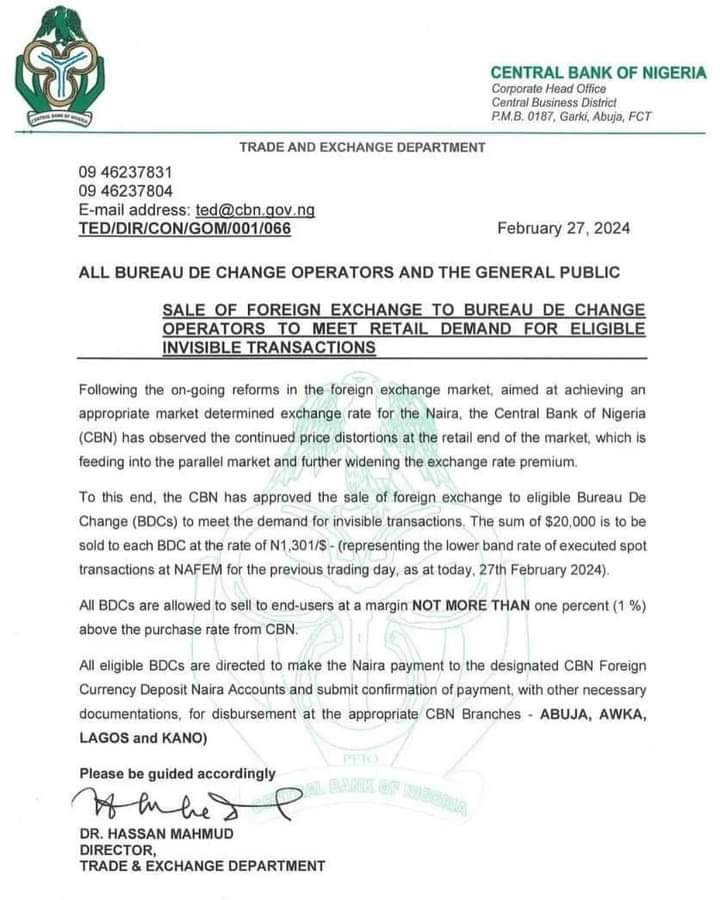
The circular, titled “Sale of Foreign Exchange to Bureau de Change Operators to meet retail demand for eligible invisible transactions,” aims to address distortions in Nigeria’s retail forex market and narrow the widening gap in exchange rates.
According to the circular, the allocated foreign exchange will be sold at a rate of N1,301 per dollar, reflecting the lower band rate of executed spot transactions at the Nigerian Autonomous Foreign Exchange Market as of the previous trading day, dated February 27, 2024.
In the circular, the CBN stated, “Following the ongoing reforms in the foreign exchange market, aimed at achieving an appropriate market-determined exchange rate for the Naira, the Central Bank of Nigeria has observed the continued price distortions at the retail end of the market, which is feeding into the parallel market and further widening the exchange rate premium.”
“To this end, the CBN has approved the sale of foreign exchange to eligible Bureau De Change to meet the demand for invisible transactions. The sum of $20,000 is to be sold to each BDC at the rate of N1,301/$- (representing the lower band rate of executed spot transactions at NAFEM for the previous trading day, as of today, 27th February 2024).
“All BDCs are allowed to sell to end-users at a margin NOT MORE THAN one per cent (1 per cent) above the purchase rate from CBN.”
Eligible BDCs are directed to make Naira payments to designated CBN Foreign Currency Deposit Naira Accounts and submit confirmation of payment along with other necessary documentation for disbursement at designated CBN Branches in Abuja, Awka, Lagos, and Kano.
The CBN, in its efforts to stabilize the naira, has implemented several reforms, including probing and clearing FX backlog, limiting forex for foreign education and medical tourism, increasing BDCs’ minimum share capital, and curbing FX speculation.
Details to follow as developments unfold.
 Instant News Blog
Leave a comment