The Nigeria Labour Congress (NLC) has firmly rejected the federal government’s proposed minimum wage increase to either ₦62,000 or ₦100,000, labeling such offers as “starvation wages.”
In an interview with Channels Television on Monday, Chris Onyeka, the Assistant General Secretary of the NLC, reiterated labour’s stance, stating that their demand for a living wage remains at ₦250,000. Onyeka emphasized that anything less is unacceptable given the economic realities Nigerian workers face.
“Our position is very clear. We will not accept ₦62,000 or any wage that does not reflect the true cost of living for Nigerian workers. Our demand remains at ₦250,000,” Onyeka asserted. “This is not a frivolous demand but one based on the cost of essential items like rice, yam, and garri.”
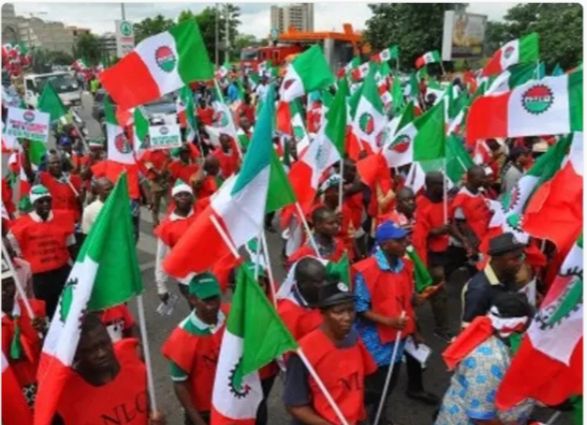
The NLC had given the federal government a one-week grace period to review its proposal, which expires at midnight on Tuesday, June 11, 2024. Onyeka indicated that if the government and National Assembly do not act on their demands, the labour unions would consider resuming their nationwide industrial action.
“The decision now lies with the Federal Government and the National Assembly. They need to send an Executive Bill to the National Assembly to establish a new National Minimum Wage Act that meets our demands. If our demands are not met by the deadline, the labour unions will decide on the next steps,” Onyeka added.
When asked about the potential outcome if the government insists on ₦62,000, Onyeka explained, “We have merely paused the nationwide indefinite strike. If the governing bodies of the trade unions decide to lift this pause, we will resume our strike actions.”
The NLC and Trade Union Congress (TUC) had initially gone on strike last Monday, demanding a new minimum wage and a reversal of the electricity tariff hike, arguing that the current minimum wage of ₦30,000 is insufficient for workers’ well-being.
Following a six-hour meeting with the National Assembly, the labour unions agreed to suspend the strike for five days, contingent on the government’s commitment to negotiate a new minimum wage within that period. President Tinubu directed Finance Minister Wale Edun to present the cost implications of a new minimum wage within two days and urged collaboration with the private sector and sub-national entities to achieve an affordable wage.
Despite these directives, by Friday, June 7, 2024, negotiations had stalled. Labour reduced its demand from ₦494,000 to ₦250,000, but the government only increased its offer from ₦60,000 to ₦62,000. Both parties have submitted their reports to President Tinubu, who is expected to draft an executive bill for the National Assembly to pass the new minimum wage into law.
The outcome of this contentious negotiation remains to be seen as the deadline approaches.
 Instant News Blog
Leave a comment