The Federal Government has concluded plans to sell a massive estate comprising 753 housing units, allegedly linked to former Central Bank of Nigeria Governor Godwin Emefiele, to low and middle-income Nigerians.
The property, which spans over 150,000 square metres and includes duplexes and other residential units, was recovered by the Economic and Financial Crimes Commission (EFCC) in December 2024. According to the agency, it represents the largest single asset recovery in its history since 2003.
The Federal Capital Territory High Court in Abuja, presided over by Justice Jude Onwuegbuzie, issued a final forfeiture order for the estate on December 2, 2024. Despite a legal challenge in April 2025 by Emefiele—who claimed the EFCC failed to inform him about the forfeiture process—his application to reclaim the estate was dismissed.
EFCC Chairman Ola Olukoyede officially handed over the estate to the Minister of Housing and Urban Development, Ahmed Dangiwa, on May 20, 2025.
Speaking to newsmen, the ministry’s Director of Press and Public Relations, Badamasi Haiba, confirmed that the estate would be assessed for structural integrity before being made available to the public.
“The estate is still under construction. The ministry will evaluate the buildings before deciding on sale and allocation modalities,” Haiba said. “But in line with President Bola Tinubu’s Renewed Hope Agenda, the intention is clear — to promote homeownership among low and middle-income Nigerians.”
He added that the properties would be sold via the ministry’s digital portal — renewedhopehomes.fmhud.gov.ng — with flexible payment options such as rent-to-own, mortgage, and instalment plans.
When asked about timelines, Haiba explained that the portal would be opened only after the construction is completed.
He also dismissed claims that the homes would be cornered by political elites. “The ministry has removed human interference from the process to ensure transparency. Interested Nigerians can apply online and receive offer letters without any backdoor dealings,” he said.
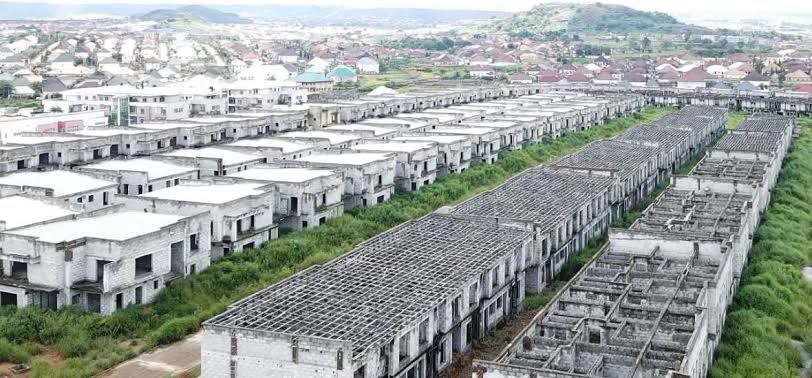
A visit to the Lokogoma site in Abuja showed signs of neglect. Construction has stalled since July 2023, shortly after Emefiele was arrested by the Department of State Services. Overgrown bushes, snakes, and reptiles have since overrun the estate, with neighbouring residents confirming the invasion.
At least two duplexes appear completed, while others remain at various stages — from carpentry to plumbing. The estate is surrounded by high-value properties, indicating its prime location.
Despite the government’s pledge to serve low and middle-income earners, stakeholders in the housing sector have raised concerns about feasibility.
Moses Ogunleye, former President of the Association of Town Planning Consultants of Nigeria, doubted whether such luxury properties could truly benefit low-income earners.
“These are likely four-bedroom duplexes. Even with subsidies, the cost of completing and maintaining them puts them out of reach for low-income Nigerians,” he said.
Similarly, Stephen Eke, CEO of Fajiri Construction Ltd., said the properties were never designed for affordability. “Retrofitting them for social housing would undermine their value. A better approach is to sell them at market value and invest the proceeds into dedicated affordable housing projects,” he advised.
Kunle Awobodu, former President of the Nigerian Institute of Building, also advocated for a professional valuation to determine fair pricing. He suggested gradual payment through mortgage schemes.
Others, like Jeremiah Akinsele of Magnificent Choice Services Ltd., and Adewunmi Okupe of Ace Hi-Tech Construction, echoed calls for either a full market sale or structural remodeling to make the estate affordable. “One duplex can be subdivided into four or more flats,” Okupe proposed.
Godfrey Godfrey, spokesperson for the Nigerian Institute of Building, and Azeez Ayodabo, General Secretary of the Nigerian Institute of Quantity Surveyors, both questioned the affordability and accessibility of the estate, citing Nigeria’s minimum wage and historic elite appropriation of public assets.
Festus Adebayo, Executive Director of the Housing Development Advocacy Network, urged the government to repurpose the estate into subsidised rental housing for vulnerable Nigerians.
He proposed a digital raffle draw, priced at N10,000 per ticket (linked to BVN), to allocate units transparently. He estimated the initiative could raise up to N10 billion if one million Nigerians participated — enough to fund completion and remodeling.
“This is a golden opportunity to turn a seized asset into a national solution,” Adebayo said.
Aliyu Wamakko, immediate past president of the Real Estate Developers Association of Nigeria, called for transparency and equal access through the ministry’s online portal.
“The portal should list the pricing and status of all units so that every interested Nigerian has a fair chance to apply,” he said.
As debate continues, all eyes are now on the Ministry of Housing to see whether it can deliver on its promise of inclusive homeownership, or, whether another elite acquisition saga will unfold.
 Instant News Blog
Leave a comment