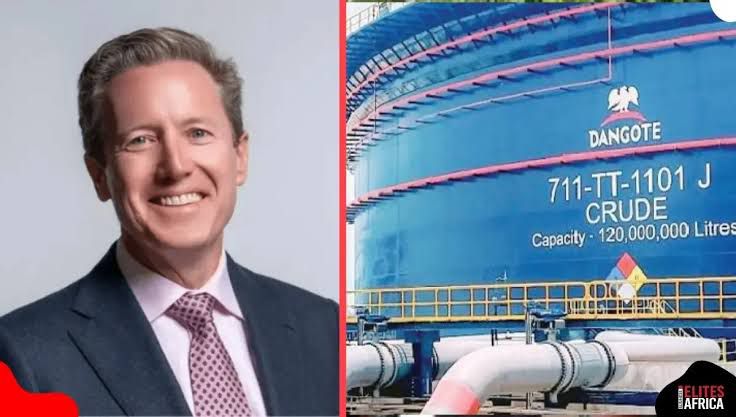
The Dangote Petroleum Refinery and Petrochemicals has appointed David Bird, former CEO of Oman’s Duqm Refinery, as its new Chief Executive Officer. The move signals a strategic shift aimed at resolving ongoing production challenges and accelerating the next phase of growth for the world’s largest single-train refinery.
According to a report by S&P Global on Friday, Bird will lead the refinery’s petroleum and petrochemicals division, bringing decades of global experience to the role. His appointment took effect in July 2025.
Bird, who previously served as Shell’s head of operations at the Balau Pokom refinery and later as CEO of Oman’s OQ8, played a key role in the Duqm refinery’s successful commissioning and crude diversification. He now steps into his role at Dangote amid growing expectations to maximize output and efficiency, especially following the complex’s commissioning in January 2024.
He was also in attendance at the recently concluded Dangote Leadership Development Program Graduation Ceremony, signaling early integration into the group’s leadership ecosystem.
Aliko Dangote, founder of the Dangote Group, will remain Chairman of the refinery business and continue to serve as CEO of the broader conglomerate, which spans cement, sugar, and fertilizer production. While Dangote retains overarching control, the appointment of Bird underscores the company’s intent to professionalize operations and strengthen its global positioning.
In a LinkedIn update, Bird expressed his commitment to expanding Dangote’s footprint beyond Nigeria and establishing a strong presence across Africa. He emphasized operational efficiency, high utilisation rates, and feedstock flexibility as core pillars of his strategy—an approach consistent with the company’s recent shift toward processing a broader range of crude grades due to limited availability of Nigerian oil.
The refinery, which has a nameplate capacity of 650,000 barrels per day, has faced several setbacks in 2025 due to unit upsets and design issues—particularly affecting its Residue Fluid Catalytic Cracker (RFCC), a key gasoline-producing unit. Although the RFCC began test runs in Q3 2024, recurring outages have forced the facility to rely on lower-yield units like the reformer.
A Dangote executive told Platts in July that the RFCC was operating at 85% capacity and denied speculation about a planned turnaround in December. Nonetheless, operational inconsistencies have led the company to export residual fuel—normally reprocessed on-site—as a stopgap.
Despite the challenges, Dangote has swiftly gained ground in Nigeria’s downstream sector, significantly reducing the nation’s reliance on imported fuel. According to S&P Global Commodities at Sea, Nigeria exported approximately 220,000 b/d of petroleum products in July 2025, with Dangote emerging as the country’s sole active refiner due to outages at Nigerian National Petroleum Company (NNPC) facilities.
In July, the complex exported 30,000 b/d of residual fuel, while jet fuel and gasoil accounted for 45% and 24% of total shipments respectively.
Bird’s appointment also comes as the refinery prepares to scale operations further. The Dangote Group plans to increase refinery capacity to 700,000 b/d, expand port infrastructure, and develop foreign storage assets in Namibia and other African nations. In August, it will also launch its own fuel distribution network using a fleet of 4,000 CNG-powered trucks.
Additionally, the group is considering a dual listing of its refining arm on the Lagos and London stock exchanges—a move Dangote has described as essential to unlocking long-term capital and enhancing transparency.
Despite its rocky start, analysts have been surprised by the pace of the refinery’s ramp-up, with its growing output already exerting downward pressure on global oil benchmarks.
 Instant News Blog
Leave a comment