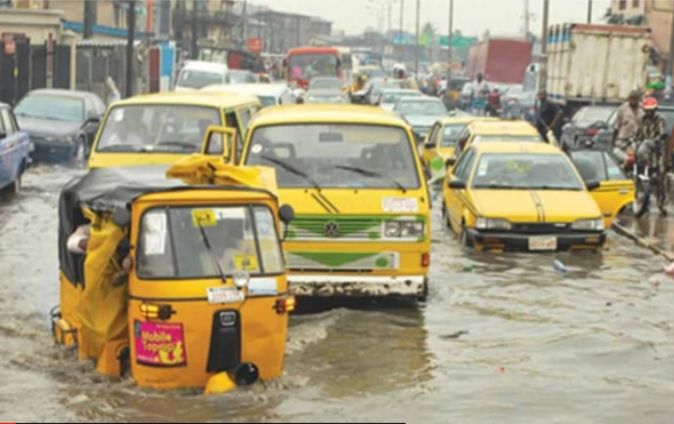
Hours of torrential rainfall on Wednesday left large swathes of Lagos State under water, paralysing vehicular and business activities across several communities.
Checks by our correspondent showed that flood-prone areas such as Maryland, Lekki, Ogba, and Ikorodu were among the worst hit, as overflowing canals and blocked drains forced residents, shop owners, and motorists into distress.
Videos circulating on social media captured residents wading through knee-deep water, while motorists crawled along submerged roads, with many vehicles breaking down in the gridlock.
On Olatunji Street, Maryland, the overflow of a canal cut off access to the adjoining Mende community.
“This has been happening for years,” resident Chinasa Nnadi said. “Some people even swim to their houses. Others have relocated because the flood makes it impossible to live here.”
A trader identified simply as Kalu said he watched helplessly as floodwater poured into his shop. Similarly, Christiana, a member of a local church, lamented that the downpour damaged the worship centre’s musical instruments.
“The water reached half the building and destroyed our instruments. We will spend a lot of money to fix or replace them,” she said.
The downpour compounded the woes of commuters. Many were trapped in traffic for hours as major junctions such as the Ogba-Wempco axis became impassable.
Commuter Tunji Abass said: “Vehicles moved at a snail’s pace. It has always been like this in the rainy season, and sometimes water even enters cars. The government must act fast.”
In Lekki and Ikate, residents narrated how flooding repeatedly disrupts daily life. Victor Obinna, who works in the area, said he sometimes sleeps at the office whenever it rains.
“By the time I get to work, half of my body is soaked,” he explained. “Sometimes I even dress up in the office.”
Weeks earlier, flooding in Ikorodu reportedly destroyed property worth millions of naira, underscoring the recurring nature of the problem. Experts estimate that Lagos loses billions of naira annually to flooding through damaged property, lost vehicles, gridlock, and health hazards from stagnant water.
Reacting to Wednesday’s incident, the Commissioner for the Environment and Water Resources, Tokunbo Wahab, said Lagos, as a coastal city, remains vulnerable to flash floods, particularly during heavy rainfall and tidal lock.
He noted that the government had intensified investments in drainage infrastructure, desilting, and enforcement of environmental laws, but warned that illegal human activities continued to worsen the problem.
“Flooding near the House on the Rock church was linked to illegal construction on floodplains and indiscriminate dumping of refuse in drains,” Wahab said.
On Lekki’s Kusenla axis, he explained that flooding was due to a technical challenge, as the downstream was higher than the existing drainage. He disclosed that the state had already awarded a project that includes the construction of a pumping station to tackle the issue.
Wahab stressed that structures built without approvals, drainage obstructions, and illegal reclamations would be removed.
He added: “We appeal for understanding and cooperation. Keeping our environment clean, avoiding refuse dumping in drains, and refraining from building on floodplains are vital to achieving a flood-free Lagos. The flooding has since receded, and we remain committed to strengthening our flood management systems, but this requires the support of all Lagosians.”
While the immediate floods have subsided, Wednesday’s chaos highlights the long-standing challenge of urban flooding in Lagos. Without stronger infrastructure and stricter compliance with environmental laws, residents fear the cycle of devastation will continue each rainy season.
 Instant News Blog
Leave a comment