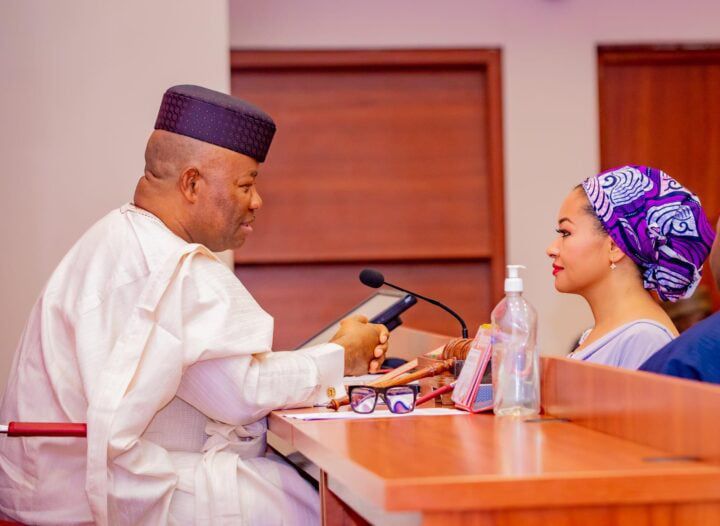
A mild drama played out in the Senate on Tuesday as Senate President Godswill Akpabio and Senator Natasha Akpoti-Uduaghan (Kogi Central) engaged in a brief exchange during deliberations on the Criminal Code Amendment Bill, which seeks to impose stiffer penalties for aiding or procuring abortions in Nigeria.
The bill, earlier passed by the House of Representatives and presented for concurrence by Senate Leader Opeyemi Bamidele, proposes to increase the punishment for anyone supplying drugs or instruments to facilitate abortion from three years to ten years’ imprisonment without an option of fine.
According to Bamidele, the amendment seeks to update Nigeria’s Criminal Code Act in line with “contemporary social, moral, and medical realities.”
However, the debate quickly became heated as lawmakers expressed divergent opinions on what constitutes an “unlawful abortion.”
Senator Saliu Mustapha (Kwara Central) argued that abortion could, in some cases, be medically necessary or even justified on religious grounds, warning that blanket criminalisation might endanger women’s lives.
Similarly, Senator Abdul Ningi (Bauchi Central) cautioned that the proposed amendment could discourage medical practitioners from performing essential life-saving procedures. He urged the Senate to suspend further consideration to allow broader consultations “so that we do not legislate in a way that endangers life.”
Following the exchanges, Senate President Akpabio ruled that the bill be stepped down and referred to the Senate Committee on Judiciary, Human Rights, and Legal Matters for further review and recommendations within two weeks.
Moments later, Senator Akpoti-Uduaghan sought recognition to contribute to the debate, appealing to the presiding officer.
“Mr. Senate President, please may I speak? I am a woman, and abortion has to do with women. It is very important, sir,” she pleaded.
But Akpabio declined, insisting that the matter had already been suspended “in totality.”
At that point, Senator Adams Oshiomhole (Edo North) raised a point of order, stressing that reopening discussion after the gavel had fallen would contravene Senate rules.
“If you grant this exemption to Senator Natasha, then you must extend it to everyone else,” Oshiomhole said. “The rules should be applied uniformly, as you have already done.”
Upholding Oshiomhole’s point of order, Akpabio cited Rule 52 (Subsection 6) of the Senate Standing Orders, which bars reconsideration of any matter that has been concluded.
“I rule Senator Natasha out of order,” Akpabio declared.
Speaking with journalists after the plenary, Senator Akpoti-Uduaghan expressed disappointment at not being allowed to speak on a bill she said directly affects women’s health and rights.
“I am disappointed I wasn’t allowed to speak on an issue that concerns women,” she said. “I am a woman, a mother and I felt I should have been recognised, especially since there were only two women present at plenary today.”
The senator, who recently returned from a six-month suspension, however expressed optimism that she would have the opportunity to make her inputs when the bill reaches the committee stage.
“I remain committed to championing issues that affect women and children in the Senate,” she reaffirmed.
 Instant News Blog
Leave a comment