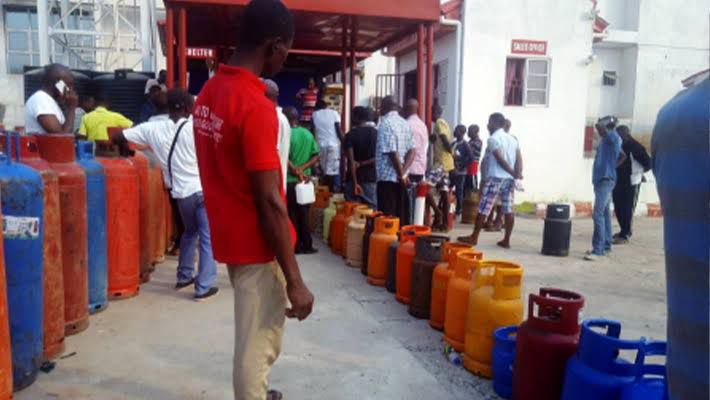
Despite assurances from marketers that the price of Liquefied Petroleum Gas (LPG), commonly known as cooking gas, would return to its pre-October levels of ₦950 to ₦1,000 per kilogram, the commodity has remained high across major cities.
A market survey conducted in parts of Lagos on Monday showed that LPG was selling between ₦1,200 and ₦1,400 per kilogram, depending on the location.
At Gasland, Igando in Ikotun, and Mac Rich Gas Plant in Cele-Okota, cooking gas was sold at ₦1,200 per kg, while other outlets around Lagos dispensed the product for ₦1,300 and ₦1,400 per kg.
Some gas plant officials, who spoke on condition of anonymity, said the current high prices were beyond their control.
“As of last month, we sold cooking gas at ₦900 to ₦950 per kg. Now we retail at ₦1,200 per kg. This is the situation we find ourselves in. We just hope the price drops in the coming weeks,” one dealer said.
Findings also revealed that bulk retailers purchasing between 150kg and 200kg currently buy at ₦1,104 per kg, indicating minimal price relief even at wholesale level.
In a phone interview, the outgoing President of the Nigerian Association of Liquefied Petroleum Gas Marketers (NALPGAM), Mr. Olatunbosun Oladapo, attributed the sustained high prices to a backlog of unsupplied products, maintenance issues, and refinery logistics challenges.
He, however, expressed optimism that the situation would normalise soon with improved supply from Seplat Energy, the Dangote Refinery, and other ongoing gas infrastructure projects.
“Normalcy should return in the coming weeks as new supplies enter the market. Seplat’s gas production and the contribution from Dangote Refinery will ease supply pressures and stabilise prices nationwide,” he said.
Speaking at the Association’s 38th Annual General Meeting (AGM), Oladapo highlighted Nigeria’s growing domestic LPG consumption, which has doubled in recent years, rising from about 900,000 metric tonnes in 2021 to 2 million metric tonnes in 2025.
“About four years ago, national consumption stood between 900,000 and 1 million metric tonnes. Today, it has risen to 2 million metric tonnes. By the first quarter of next year, we expect it to reach 3 million metric tonnes per annum,” he said.
He attributed the growth to increased private investment, stronger collaboration with government agencies, and growing public adoption of gas as a household energy source.
Oladapo added that with sustained policy support and private sector participation under the Federal Government’s “Decade of Gas” initiative, the association’s long-term target of achieving 6 million metric tonnes per annum is attainable.
“Through our collaboration with the Federal Government under the Decade of Gas initiative, we have been able to deepen the future of LPG in Nigeria,” he stated.
 Instant News Blog
Leave a comment